
Sheree Hovsepian
Becoming
March 5, 2026 - April 16, 2026
Stockholm
Carling Dalenson is pleased to announce the upcoming exhibition Becoming with Iranian-American artist Sheree Hovsepian. This marks the first time her large-scale sculptures are shown in Europe. The exhibition also includes her ongoing series of three-dimensional collages that integrate silver gelatin photographs, ceramic pieces and string in deep walnut frames. This series was first presented in Europe at the Venice Art Biennale exhibition The Milk Of Dreams, 2022, at the Central Pavilion.
Hovsepian’s practice bridges photography, collage, and sculpture, beginning with photography as a material and conceptual foundation. In Becoming, mixed-media collages combine analog photographs with string, wood, paint, ceramic, and ephemera, extending the image into physical space. Three freestanding bronze sculptures further develop these concerns, translating photographic ideas of trace, presence, and transformation into three-dimensional form. Deliberate and tactile, the works always emphasize formation over completion, underscoring the fluid boundary between image and object, state and becoming.
Biography
Born in Isfahan, Iran in 1974, Sheree Hovsepian currently lives and works in New York City where she is represented by the gallery Uffner & Liu. She earned her MFA from the School of the Art Institute of Chicago in 2002, following a dual BFA/BA from the University of Toledo, and additional studies at the Glasgow School of Art. Her work has been exhibited widely, both in the United States and internationally, including the 59th International Art Exhibition of La Biennale di Venezia, The Milk of Dreams. Her artworks are held in numerous prominent institutional and private collections worldwide. The body is central to Hovsepian’s work, not as a fixed image, but as something relational shaped through acts of looking, lived memory, and material intervention. She often photographs her sister, chosen for her physical resemblance, as a stand-in for herself. This substitution enables a fluid position in which the artist is simultaneously observer and observed, subject and object – foregrounding photography’s capacity to act as both an archival process and a site where the indexical and the unknown coexist. Building on this tension, Hovsepian’s work persistently challenges photography’s indexical claim to truth. Rather than functioning as a definitive record, the photograph appears as a trace in flux, vulnerable to time and reinterpretation. Across the collages, images are interrupted, extended, or completed by material interventions, while the sculptures engage scale, weight, and duration. Together, these works suggest identity not as an essence but as an ongoing process – a shaped and negotiated act of becoming. The engagement with the body and identity as relational is inseparable from Hovsepian’s lived experience and her desire to establish a place of belonging. Having immigrated from Iran to Ohio at a young age, she grew up with an acute awareness of the body as a politically charged site. The body emerges in her work as both familiar and estranged, a place where personal history, desire, and external perception intersect. String, with its associations to time, mapping, and textile practices, operates as connectivetissue and gesture, while ceramic and wooden elements act like added body parts, extending or altering the figure without resolving it into a final form.
Hovsepian’s bronze sculptures are constructed from motifs long present in her photographic and collage-based work, most notably the elongated half-moon form. In moving these recurring shapes from the flat, indexical surface of photography into weighty bronze, the artist allows familiar visual language to undergo a material transformation, as a way of situating the self physically. This recent turn toward sculpture extends her ongoing inquiry into how ideas migrate across mediums, retaining memory while assuming new bodily presence. Across both collage and sculpture, Hovsepian develops a visual vocabulary rooted in image, object, and gesture, where each element contributes to an evolving syntax of meaning.
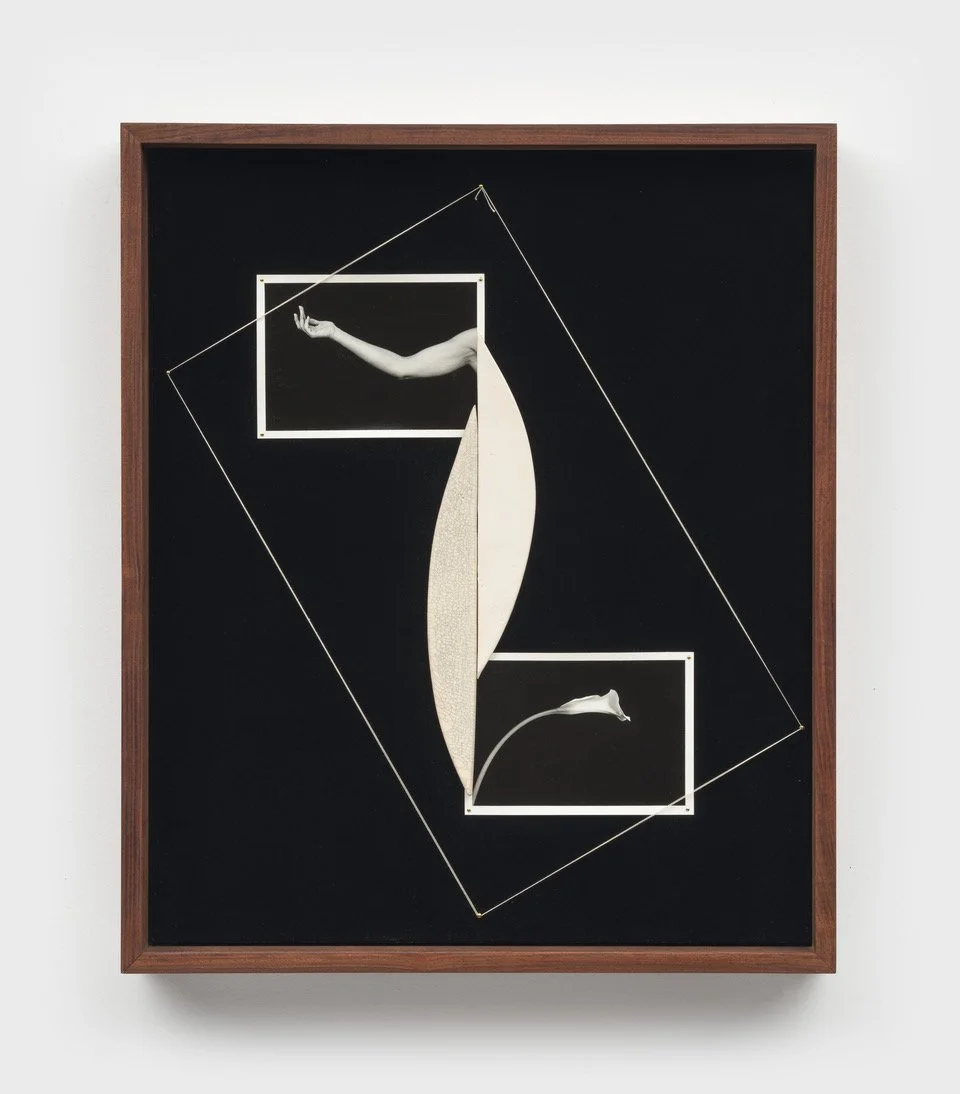
© Sheree Hovsepian
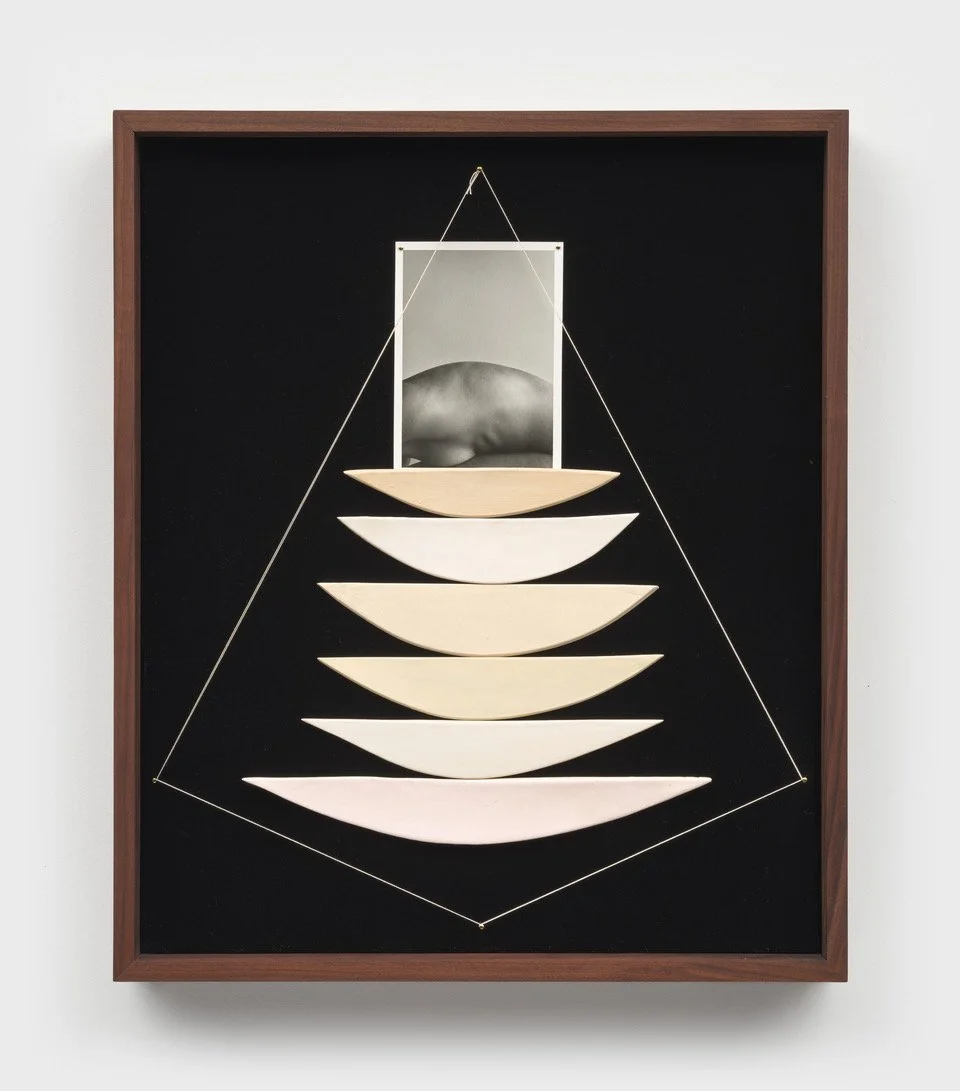
© Sheree Hovsepian